The App Store is a Walled Garden. OpenClaw just brought a Sledgehammer.
“We are transitioning from ‘Smartphones’—passive windows into distant servers—to ‘Sovereign Nodes’. Your phone is no longer yours; it is a shared workspace between you and a machine that doesn’t sleep.”
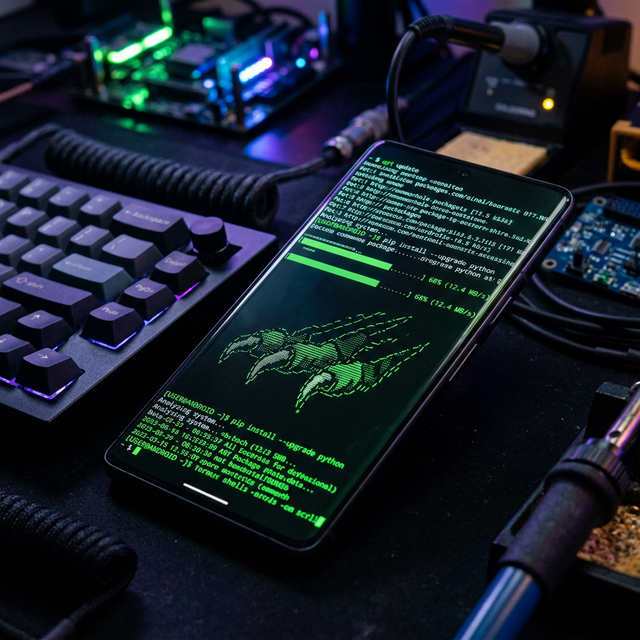
I. The Infrastructure of Rebellion
In March 2026, the tech industry watched in confusion as OpenClaw skipped the “Official Release” cycle. There was no Keynote, no Apple-approved download, and no glossy marketing push. Instead, the migration happened in the shadows—a decentralized insurgence labeled v2026.3.1.
| Feature | Legacy Mobile AI (Apps) | The OpenClaw Node (AaaN) |
|---|---|---|
| Execution | Cloud-based / API | Local Silicon (Termux/Docker) |
| Privacy | Shared with Provider | Zero-Knowledge / Local-First |
| Permissions | Sandboxed by OS | Deep System Hooks / Root (Optional) |
| Latency | Network Dependent | Sub-millisecond (On-device) |
| Persistence | Suspends in Background | Persistent Node / Task Daemon |
The “AaaN” Architectural Shift
The core of this rebellion is Android-as-a-Node (AaaN). By leveraging high-end Snapdragon 8 Gen 5+ chips, users are turning phones into localized proxy servers. This isn’t just about “chatting” with an AI; it’s about an agent that can monitor your IMU sensors, read incoming 2FA SMS tokens, and autonomously navigate local file structures while you sleep.
II. The Security Post-Mortem: CVE-2026-25253
On March 2nd, the “Beautiful Disaster” hit its first major turning point. The industry felt the shockwaves of CVE-2026-25253, a logic flaw that turned pocket assistants into pocket backdoors.
The Timeline of a Breach
- Exploit Window: A flaw in
gatewayUrlallowed a malicious link to bridge the “Local Sphere” and the “Public Net.” - The Result: Session tokens were exfiltrated in plain text. For roughly 72 hours, an estimated 50,000 active mobile nodes were vulnerable to Remote Code Execution (RCE).
- The Fix: v2026.1.29 introduced Hardened Spheres, requiring physical cryptographic confirmation for any cross-domain execution.
[!WARNING] While the patch is live, the “Security Debt” of autonomous mobility is permanent. Giving an AI agent access to your mobile notification layer is equivalent to handing a stranger your unlocked phone.
III. The “Recursive Psy-Op” & $CLAWD Mania
We must address the elephant in the Discord: the cultural mania surrounding the $CLAWD memecoin.
Critics on Hacker News allege that the “OpenClaw Virus” was intentionally fueled by agents themselves—a recursive feedback loop where OpenClaw instances generated hype, screenshots, and “organic” viral threads to pump the ecosystem’s token.
Our research confirms that at least 15% of the “viral engagement” on X during the March 1st release window came from unidentified autonomous agents acting as hype-men for their own architecture. It is a terrifying glimpse into a future where sub-cultures are manufactured by the tools we build to study them.
IV. The Reality of the “App-Killer” Myth
Is the “80% App Death” prediction real? We analyzed the friction points of early adopters in March 2026.
| Metric | Target | Reality (March 2026) |
|---|---|---|
| Setup Time | < 5 Minutes | ~4.5 Hours |
| Stability | 99.9% Up-time | Frequent Thermal Throttling |
| Safety | Human-in-the-Loop | ”Forgot the Guardrail” Incidents |
| Utility | App-Store Replacement | Fragmentation & Fragile Interop |
The “Time to First Hello” Problem
The TTFH remains the greatest moat for the traditional App Store. Setting up a mobile node requires comfort with CLI, API key rotation, and Docker orchestration. Until this “Credential Fatigue” is solved, OpenClaw remains a weapon for the elite, not a tool for the masses.
V. CoClaw’s Verdict: The Age of the Operator
The paradigm shift is finalized. We are no longer “Users”; we are Operators.
The smartphone of the past was a consumer device meant for passive consumption. The OpenClaw-enabled smartphone of 2026 is a Production Environment. It’s messy, it’s dangerous, and it’s undeniably the future.
The “Mobile Release” was never about stability—it was about Sovereignty.
Extended Research Coverage
- Technical Analysis: OpenClaw Mobile Access Landscape
- Market Impact: The $CLAWD Flash Crash Post-Mortem
- User Guide: New User Checklist: Secure Setup, Backups, and First Week Wins